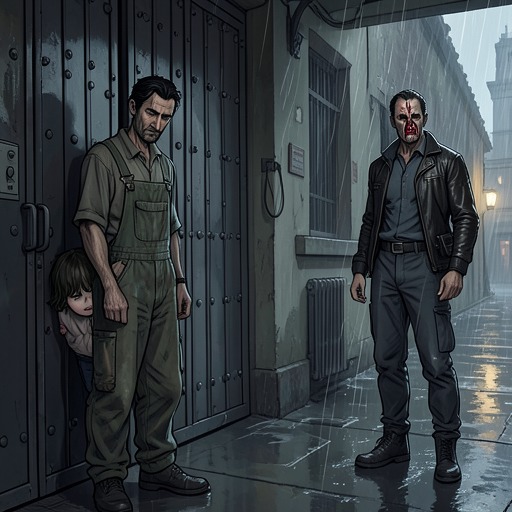
Jean Florian
Impure BloodJean Florian’s life is shaped by a secret exchange at birth: he is the Jewish child of Louise and Marcel Florian, raised under a different identity after Adam Djourescu carried him into the Florians’ apartment during a wartime raid. The truth reaches Jean decades later through his son Emil, offering an explanation for his family’s rejection of him but also setting in motion a painful attempt to recover his estranged son David.
Birth and Hidden Identity
Jean is born to Louise Florian after a pregnancy that becomes complicated near its end. A neighbor, Madame Laseige, is present as a young mother offering assistance when Louise gives birth to a stillborn boy. Only hours later, Elena Djourescu gives birth to a healthy son. Madame Laseige does not witness that birth, but she remembers what follows: soldiers enter the building, and Adam Djourescu runs past her carrying a living newborn toward Louise and Marcel’s apartment. Before the soldiers reach the top landing, Adam returns to his own apartment carrying a bundle that is no longer moving.
The account overturns the version in a police report, which had identified Elena as the mother of the baby who died. The child Adam carried to Louise and Marcel was ultimately known as Jean Florian. The exchange concealed Jean’s birth family and connected his identity to the fate of the Djourescus, whose betrayal by a fellow officer led to their deportation to Auschwitz.
The Revelation and Its Consequences
Jean learns the truth from a letter Emil wrote twelve months before the present events. After reporting that their father had died, Emil tells Jean not to expect anything from the will and claims that Jean is not a true Florian. He says his mother had revealed that Jean was a Jewish baby given away at birth, and recounts the story of Adam and Elena Djourescu. Emil’s mother, as Jean understands it, did not know the informant’s full identity; the only name available to him was Vincent.
The revelation gives Jean a new explanation for the way the Florian family treated him after Emil arrived. He also recognizes a painful repetition in his own conduct: he had treated his wife and son with the same cruelty he associated with his own family’s treatment of him. His wife left and took David with her, later returning to her maiden name, Jarret. Jean did not blame her or David for hating him, but by the time he understood what he wanted to explain, his wife had died.
Fatherhood and a Chance at Reconciliation
For Jean, telling David what Emil had revealed was not an effort to avenge the original crime. He wanted his son to know what had happened to his true grandparents and hoped that sharing the truth might restore their relationship. David, however, appears to have taken the revelation in a different direction. Jean’s attempt to reach him therefore carries a double consequence: it brings David back into contact with his father, but may also lose him again.
At the end of the account, Jean is told that a police officer will question him about his son, who is suspected of responsibility for Emil’s death and other serious crimes. Jean wants only to turn back time and regrets telling David what Emil’s letter disclosed. A telephone is held to his ear so that he can hear the officer’s questions and respond through an intermediary. The police questioning frames his final hope against the possibility that the truth he passed on has become inseparable from the crimes attributed to his son.
Identity, Inheritance, and Repetition
Jean’s hidden origins make family identity an inheritance imposed by others and withheld until late in life. The exchange at birth saves him from the fate that overtakes his birth parents, yet it also leaves him ignorant of his history and unable to understand the rejection he experiences in the Florian household. Once the secret is disclosed, explanation does not undo the damage: Jean can identify a pattern of emotional neglect across generations, but his attempt to break it arrives after his wife’s death and amid his estrangement from David.
His story turns on the difference between wanting to tell the truth and controlling what that truth will mean to someone else. Jean shares the revelation in the hope of restoring a father–son bond; David’s response remains beyond his control. The resulting uncertainty gives Jean’s last attempt at reconciliation its force: disclosure brings a chance of renewed contact, but not assurance of forgiveness or return.